


What Documents Do You Need for the 2026 Tax Filing? And What to Know Before You File
Don’t let tax filing trip you up! The first step is to stay calm and get your tax documents ready. Filing your taxes takes attention to detail. If you forget even one deduction, you could end up paying more tax than necessary. That’s why it’s crucial to go through your basic tax deductions carefully. For 2026, you can file your taxes online until 8 April 2027. But before you even start, it’s advisable to prepare your documents in advance. Some documents may take time to obtain, so getting things sorted early will help you avoid any delays. The sooner you submit everything, the faster you’ll get your tax refund. Let’s take a look at the essential documents you’ll need. Are they already in hand?
If the article is too long, you can choose a topic to read:
1. What should you know before filing your taxes?
2. Important documents to prepare before filing
3. What documents are needed in each category?
4. What to do if you miss the deadline?
1. What should you know before filing your taxes?
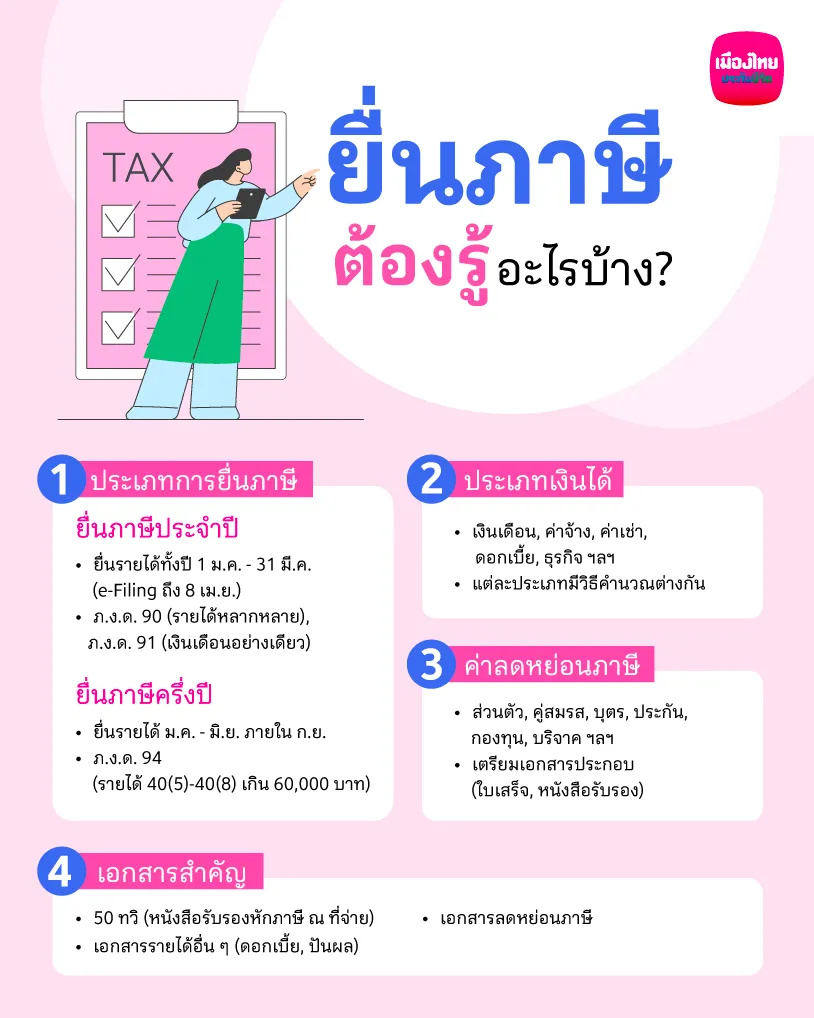
Filing taxes might bring a few tears, but it has to be done. It’s a duty for everyone with income. This year, you can file in person with documents from 1 January to 31 March 2025, or file online until 8 April 2025. Tax filing can be done at your nearest Revenue Office or online through the Revenue Department’s website. Whether you’re filing for the first time or you’re already a tax-filing pro, it’s worth reviewing what you should know before starting.
1. There are two main types of personal income tax filing.
Annual personal income tax filing
- This covers income earned throughout the previous tax year.
- Normally filed once a year, from 1 January to 31 March of the following year.
- If filing online via the Revenue Department’s e-Filing system, the deadline is extended to 8 April.
- Use P.N.D. 90 if you have multiple sources of income (e.g. salary, wages, business, or property income).
- Use P.N.D. 91 if your only income is from salary.
Mid-year personal income tax filing
- Covers income earned during the first half of the year (January–June).
- Must be filed within September of that tax year.
- Use P.N.D. 94.
- Typically required for those earning income under sections 40(5)–40(8) (e.g. rent, freelance work, construction contract, or other types of income) totaling 60,000 Baht or more between January and June.
2. Types of income
- Understand what type of income you earn: salary, wages, commission, rental income, interest, dividends, or business income.
- Each type has different rules for deductions and expense allowances.
3. Allowances
- Learn about the allowances you’re eligible for, such as personal allowance, spouse allowance, child allowance, parental care allowance, allowance for and health insurance premiums, mutual funds (SSF, RMF, Thai ESG), and allowance for donations.
- Prepare documents to support each allowance, like receipts, premium payment certificates, or certificates of donation.
4. Documents to prepare
- Withholding Tax Certificate (50 bis) from your employer
- Other income statements, such as certificates for interest or dividend income
- Supporting documents for all applicable allowances
5. Tax calculation
- Learn how personal income tax is calculated so you know how much you owe, or how much refund to expect.
- Use the online tax calculator provided by the Revenue Department to assist with your calculations.
6. Ways to file
- Choose the most convenient filing method for you, for example, online via the Revenue Department’s e-Filing system, or filing at your local Revenue Office.
- Filing online is usually more convenient, and the deadline tends to be longer too.

2. Important documents to prepare before filing
As mentioned earlier regarding things you need to know before filing taxes, one of the important parts is preparing your tax documents. Before filing personal income tax, it is essential to prepare all documents and information thoroughly so the filing process can go smoothly and correctly. The main tax documents that must be prepared are as follows:
- Income proof documents, salary certificate (50 bis) from the employer. The 50 bis document will include important details such as total income showing how much income you earned that year, or the total Social Security contributions, etc.
- Documents for various tax-deductible expenses collected throughout the year, such as child or parent support expenses, life or health insurance premiums, Easy E-Receipt documents, etc.
3. What documents are needed in each category?
Now that we know what documents we need to prepare, let’s take a look at what is included in each category so that we can be ready before filing taxes.
Allowance for personal and family responsibilities
- Certificate of parental care deduction (L.Y.03)
- Certificate of disabled person care deduction (L.Y.04)
- Certificate of being a caregiver of a disabled person (L.Y.04-1)
- Marriage certificate
- Child certification documents
- Medical certificate, receipt, or other evidence showing payment for antenatal care and childbirth at a medical facility
Allowance for insurance
- No need to prepare documents for parents’ health insurance premiums either, but you must inform the agent or insurer that you intend to claim the deduction.
Allowance for savings and investment
- Anyone with investment funds should prepare a certificate of for SSF/RMF funds.
Allowance for economic stimulus measures
- Those with a home or condo loan should request a certificate of interest paid on the home loan from the bank.
- A copy of the shareholder register showing the taxpayer’s name as a shareholder on the date of shareholding, or if investing in the formation of a company or partnership, the documents can be requested from the Department of Business Development, Ministry of Commerce.
Allowance for donations
- If donating via e-Donation, no document preparation is needed because the Revenue Department can check in the system.
- For general donations, a certificate of donation or a receipt showing the taxpayer's name as the donor is required.
- For political party donations: receipt or other supporting evidence confirming that the taxpayer has donated to a political party, such as a transfer of ownership deed showing the taxpayer donated to the political party, etc.
4. What to do if you miss the deadline?
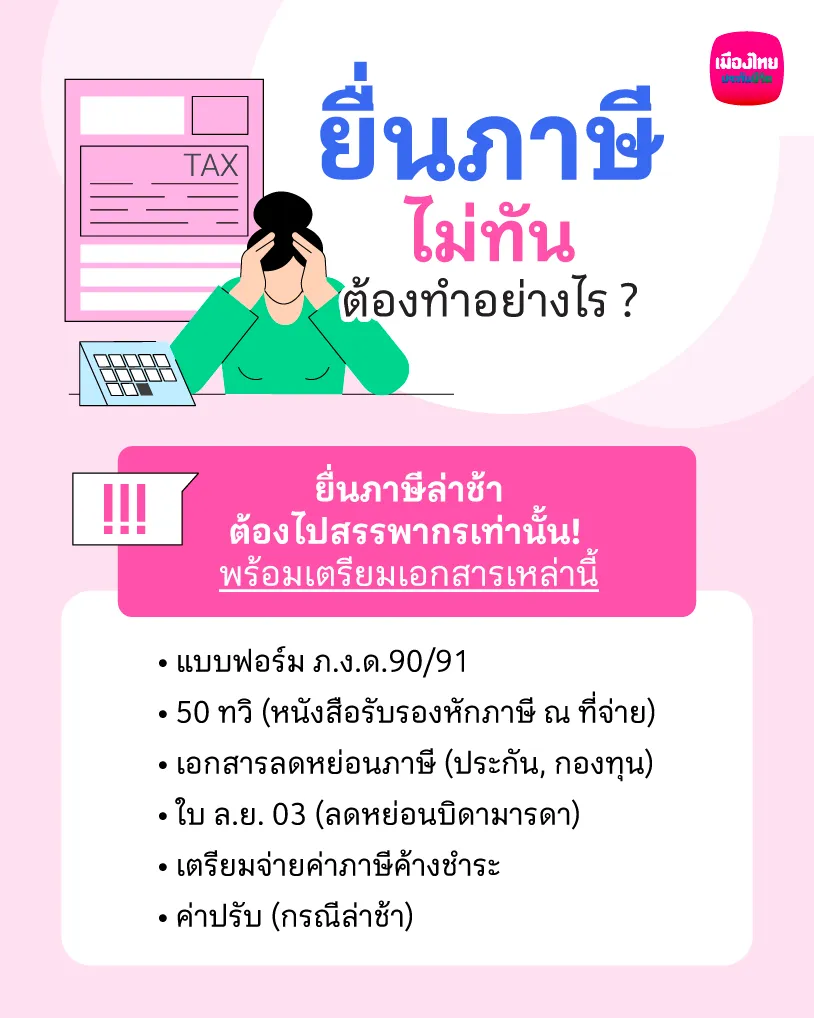
Whatever the reason for missing the tax deadline, remember to prepare your related tax documents and submit them at the revenue office only! This filing cannot be done online. It is recommended to prepare the following documents
- N.D. 91 or P.N.D. 90 form
- Certificate of Withholding Tax (50 bis)
- Documents related to tax deductions, such as a certificate of life insurance premium payment or a certificate of provident fund contribution
- Certificate of parental care deduction rights (L.Y. 03 form)
- Prepare money. In addition to the outstanding tax payment, you may also have to pay a fine, which is the penalty for late filing.
Penalties for late tax filing
If you file your taxes after the deadline, the penalties are as follows:
- Criminal fines
- In case of failing to file the form:
- Filing late within 7 days: 100 Baht fine
- Filing more than 7 days late: 200 Baht fine
- Maximum fine not exceeding 2,000 Baht
- In case of deliberately failing to file to evade tax:
- Subject to a fine not exceeding 5,000 Baht or imprisonment not exceeding 6 months, or both.
- Subject to a fine not exceeding 5,000 Baht or imprisonment not exceeding 6 months, or both.
- Surcharge
- A surcharge of 1.5 percent per month on the tax owed, counted from the day after the due date until the tax is paid (any fraction of a month is counted as a full month).
- Fines
- If a revenue officer finds that you failed to file, underpaid, or paid less tax than required:
- You must pay additional tax of 1 to 2 times the tax owed, depending on the violation.
- You must pay additional tax of 1 to 2 times the tax owed, depending on the violation.
- Criminal penalties
- In case of intentionally providing false information or evidence to avoid paying tax:
- Punishable by imprisonment from 3 months to 7 years and a fine from 2,000 Baht to 200,000 Baht.
That concludes the preparation of tax documents. For those who are still hesitating, we recommend filing as soon as possible, because the sooner you file, the sooner you’ll get your tax refund. Once you’ve planned your tax filing, don’t forget to also plan your tax deductions. Get double the benefits, both health coverage and tax deduction, with lump sum health insurance from Muang Thai Life Assurance, which covers treatment expenses from 200,000 Baht up to 100,000,000 Baht, and allows a premium tax deduction of up to 25,000 Baht.
For more information:
☑️ Call Tel. 1766, available 24/7.
☑️ Contact a Muang Thai Life Assurance agent/service channel.
- Please study the details of coverage, conditions, and exclusions before making a decision to purchase insurance.
Sources: Retrieved on 10/03/25
🔖 Thai PBS