

Rebalance Your Portfolio, Long-Term Financial Stability for MUANGTHAI Unit-Linked Customer
Rebalance Your Portfolio This New Year for Long-Term Financial Stability
2025 Investment Overview | Insights into Recommended Portfolio Allocations for 2026
If the article is too long, you can choose a topic to read:
- Investment Overview for 2025
- Performance Through Risk-Based Recommended Portfolios
- Investment outlook for 2026
- Investment Recommendations
▶️Investment Overview for 2025
2025 was a year in which global financial markets delivered strong returns, despite high volatility during the year following the United States’ announcement of retaliatory tariff measures against trading partners. Nevertheless, the global economy, particularly the U.S., remained fundamentally strong. Key drivers came from the investment sector (especially AI) rather than consumption, while the unemployment rate increased, prompting the U.S. Federal Reserve (Fed) to begin easing monetary policy further.
Investment summary for 2025
- Most major equity markets delivered positive returns.
- The U.S. stock market rose by more than +17.1% (as of 10 December 2025).
- Gold prices surged amid concerns over geopolitical issues, stock valuation levels, and economic growth prospects.
▶️Performance Through Risk-Based Recommended Portfolios
Over a 9-year period (as of the end of November 2025), since the establishment of risk-based recommended portfolios, the investment environment has experienced various events that created market volatility. Over the past 9 years, Thai stocks delivered an average return of only 1.2% per year, while portfolio-based investments (pink text) generated moderate returns compared with all asset classes. This was due to diversification across a wide range of assets, which reduced the likelihood of negative returns in certain years and provided long-term consistency for clients’ investments (based on historical data from 2017 to 2025, only two years—2018 and 2022—recorded negative returns).
Comparison Table of Performance Between Portfolio-Based Investment
and Investment in Individual Asset Classes
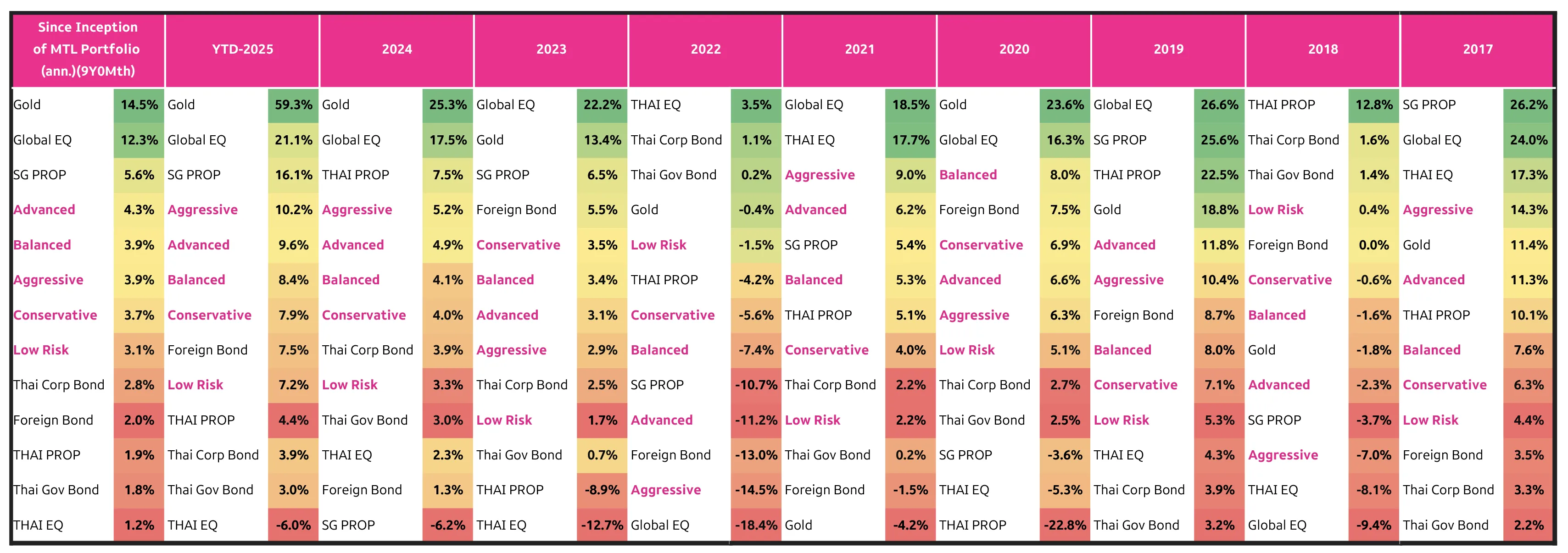
Warning: Past performance is not indicative of future results.
Source: Investment Management Division, data as of the end of November 2025 (returns include dividends, and for foreign assets, returns are based on local currency).
▶️Investment outlook for 2026
The International Monetary Fund (IMF) expects that:
- The global economy would continue expanding, albeit at a slightly slower pace, with growth projected at 3.1%, down from 3.2% in 2025, reflecting that the global economy remains on a growth path.
- The U.S. economy would grow by approximately 2.1%, which is considered strong compared with other developed economies. Key support is expected to come from private-sector investment, particularly in technology and AI.
- Household consumption would grow at a slower pace in line with a labor market that is beginning to ease, but this has not yet signaled an economic contraction.
- Monetary policy: Major central banks would adopt more accommodative policies as inflationary pressures gradually ease.
- Inflation remains above target in some countries, but the overall trend is moderating.
- A key risk that requires close monitoring is fiscal deficits in many countries, particularly the United States, where deficit levels remain persistently high. Events impacting investor confidence may lead to increased financial market volatility.
▶️Investment Recommendations
Investments continue to be supported by the growth of listed companies’ earnings, particularly in overseas stock markets. However, uncertainty from fiscal policy and interest rate direction means that diversification remains important.
Adjustment of recommended portfolio strategies by risk level for 2026
✅ Emphasize diversification across a wide range of assets to cope with potential volatility.
✅ Reduce allocation to Thai fixed income and increase investment in foreign fixed income to enhance opportunities to benefit from global interest rate trends.
✅ Reduce the role of Thai stocks in the portfolio and increase allocation to global stocks to capture opportunities from global economic growth supported by listed companies’ earnings, particularly in the technology and AI sectors.
✅ Increase allocation to Asia-Pacific stocks (excluding Japan) to diversify away from the U.S. market and enhance opportunities to benefit from growth in Asian countries that continue to show higher-than-global-average economic expansion over the long term.
In the table below, we have assessed the expected returns* and evaluated the level of investment risk for each portfolio over the next 10 years. This represents an investment plan suitable for investors at each risk level, to help you achieve your long-term investment goals.
Table showing expected returns and investment allocation for 2026
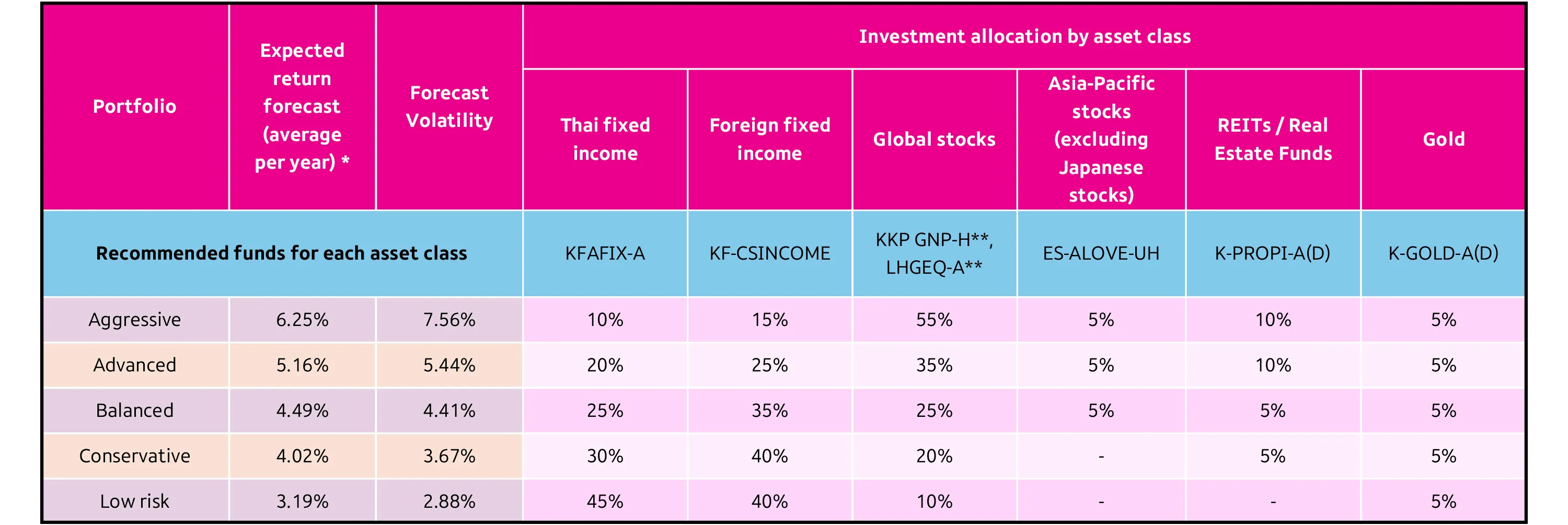
*Expected returns are not a guarantee of actual returns. Investors may achieve returns higher or lower than the expected returns shown in the table, depending on the actual investment situation. The expected returns and return volatility figures are compiled from assessments of the future economic conditions over a 10-year horizon, which affect the return expectations of each asset class.
**The recommended foreign equity fund is will invest in the KKP GNP-H fund in a portion of 50% and
LHGEQ-A fund in a portion of 50% (approximately) of the total foreign equity proportion in the investment
portfolio.
Source: Investment Management Division, examples of five investment portfolios by risk level
Remarks: Investment has risks. Investors may not achieve the expected returns of the recommended investment portfolios, or may incur losses from investing in the recommended portfolios. The recommended investment portfolios are provided for consideration only. In investing in the recommended portfolios, investors may face currency risks from foreign investments. Investors must understand the nature of the funds, return conditions, and risks before making investment decisions. The allocation of investments in each of the 5 investment portfolios will vary according to objectives, investment terms, and risk tolerance. Estimated returns and risks are based on past data and assessments of economic conditions, investment conditions, and market trends for each asset, which may change in the future. When investing in the recommended portfolios, the actual value of assets may increase or decrease, causing the actual investment proportions to differ from the original recommended investment proportions. Investors should consider buying or selling to maintain the original asset allocation recommended. The recommended investment portfolios are not guaranteed returns, and investors have the opportunity to achieve returns higher or lower than expected returns, depending on the actual returns from each asset in each year. The appropriate investment horizon is investing for at least 10 years. | * “Expected returns” refer to the returns anticipated from each risk level of the investment portfolio over a 10-year period, while “expected return volatility” denotes the anticipated level of volatility in returns from investing over a 10-year period for each risk level of the investment portfolio.
Remarks: Investing carries risks. You may not achieve the expected returns of the recommended investment portfolios, or you may incur losses from following the recommended portfolios. The recommended investment portfolios are merely proposed investment models for your consideration. When investing in the recommended portfolios, investors may face currency risks from overseas investments. Investors should understand the fund characteristics, return conditions, and risks before making investment decisions. The five recommended portfolio models are tailored to different objectives, investment requirements, and risk tolerance. The investment weights, estimated returns, and risk levels are derived from historical data and an evaluation of economic conditions, investment climates, and market trends for each asset class, which may change in the future. When you invest in the recommended portfolios, the actual asset values may rise or fall, causing the actual investment allocation to deviate from the original recommended portfolio allocation. Investors should consider buying or selling assets to maintain the recommended portfolio allocation. The recommended portfolios do not guarantee returns, and investors may experience returns higher or lower than the expected returns, depending on the actual performance of each asset class in any given year. The appropriate investment period for these portfolios is at least 10 years. ”Expected return” refers to the return expected from each portfolio's risk level over a 10-year investment horizon. “Expected return volatility” refers to the expected volatility in returns over the 10-year investment period for each portfolio's risk level.
Feel more confident…
rebalance your portfolio according to the recommended portfolio
Apply for for free!
For all Muang Thai Unit-Linked customers
Rebalance according to the recommended portfolio today
through MTL Click Application

Download Now!