

_Clcik_830_en.webp?format=webp)
UNLOCK Growth Opportunities Even in a Volatile Market
UNLOCK Growth Opportunities Even in a Volatile Market Introducing New Funds and Enhanced MTL Portfolio Management
If the article is too long, you can choose a topic to read:
- Investment Outlook
- Strategic Adjustment of Recommended Portfolios According to Risk Levels in 2026
- Why invest in a Global Multi-Asset Income Fund?
- Investment Policy (Summary)
- Past Performance
▶️Investment Outlook
- Global financial markets are volatile and vary across regions.
- The U.S. stock market is facing pressure from high valuation levels, particularly in the technology and AI sectors.
- Major central banks around the world, especially the U.S. Federal Reserve, are expected to become more cautious in easing monetary policy.
- Investors are placing greater importance on high-quality assets that can generate consistent income streams.
Under these conditions, the strategy’s portfolio focuses on selecting fundamentally strong stocks with attractive valuations, with a forward P/E of around 11.7x, compared with the global equity market at approximately 19.4x. The portfolio also emphasizes diversification across a wide range of assets to help generate steady income and reduce volatility. Therefore, the Global Multi Asset Income strategy remains appealing for investors seeking consistent income while maintaining opportunities for long-term capital growth.
▶️Strategic Adjustment of Recommended Portfolios According to Risk Levels in 2026
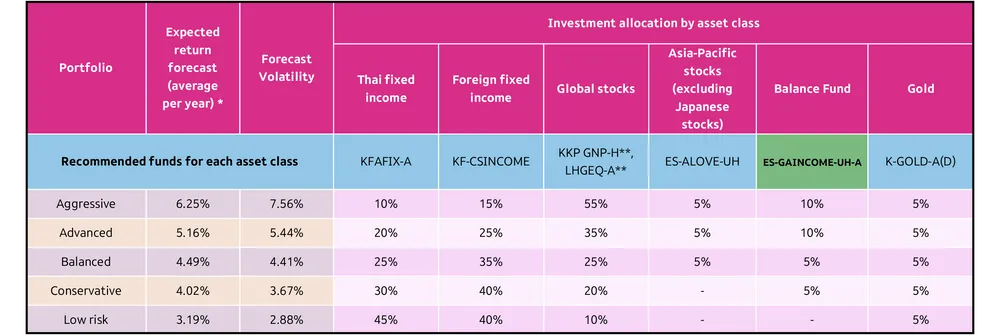
*Expected returns are not a guarantee of actual returns. Investors may achieve returns higher or lower than the expected returns shown in the table, depending on the actual investment situation. The expected returns and return volatility figures are compiled from assessments of the future economic conditions over a 10-year horizon, which affect the return expectations of each asset class.
**The recommended foreign equity fund is will invest in the KKP GNP-H fund in a portion of 50% and LHGEQ-A fund in a portion of 50% (approximately) of the total foreign equity proportion in the investment portfolio.
Source: Investment Management Division, examples of five investment portfolios by risk level
▶️Why invest in a Global Multi-Asset Income Fund?
A key strength of a Global Multi-Asset Income Fund is its ability to generate income from diversified sources through investments across multiple asset classes and regions worldwide. These include high-dividend equities, government and corporate bonds, as well as other income-generating assets. Having diversified sources of income across various asset classes helps reduce the risk of relying too heavily on any single type of asset.
The recommended fund in the Global Multi-Asset Income category is Eastspring Global Multi Asset Income Fund (ES-GAINCOME). The fund primarily invests in Amundi Fund Income Opportunities (the master fund), specifically in Class I2 USD units, managed by Amundi Luxembourg S.A., with an average investment of not less than 80% of the fund’s net asset value during the accounting period.
The fund is managed by Amundi’s fund managers, who have an average of more than 27 years of investment experience. The team consists of three fund managers: Marco Pirondini, with 33 years of experience; Fergal Jackson, with 28 years of experience; and Howard Weiss, with 21 years of experience.
▶️Investment Policy (Summary)
- The fund primarily invests in Amundi Funds Income Opportunities (the master fund), specifically in Class I2 USD units, managed by Amundi Luxembourg S.A.. The investment will, on average during the accounting year, be not less than 80% of the fund’s net asset value (NAV).
- The master fund adopts a flexible investment approach by investing globally in various income-generating securities, including those in emerging markets. These may include equities, government bonds, corporate debentures, and short-term debt instruments. The master fund may also invest in derivatives for efficient portfolio management and may invest in debt securities with either investment-grade or below investment-grade credit ratings.
- The fund is suitable for investors seeking returns from a diversified range of global assets, with a focus on generating relatively high income and who are able to accept investment risk.
- Risk level: 6
- The fund does not have a dividend payment policy.
- Foreign exchange risk hedging policy
- ES-GAINCOME-A (Hedged): The fund has a foreign exchange hedging policy at the fund manager’s discretion.
- ES-GAINCOME-UH-A (Unhedged): The fund does not have a foreign exchange hedging policy.
▶️Past Performance (January 31, 2026)
| Performance | Year to Date | 1 Year (% p.a.) | 3 Years (% p.a.) | 5 Years (% p.a.) | Since Inception (% p.a.)* |
| Master Fund | 2.40% | 22.40% | 11.40% | 9.80% | 7.40% |
| 65/35 Index** | 1.10% | 12.00% | 8.90% | 4.00% | 5.50% |
* The master fund refers to Amundi Funds Income Opportunities – I2 USD, which was established in May 2018.
**The master fund is actively managed. The fund manager is not constrained by a benchmark when constructing the portfolio and has full discretion in investment decisions. Therefore, there is no official benchmark for performance comparison. However, investors may use a blended index consisting of 65% U.S. fixed income securities and 35% global equities (USD) as a reference for comparison with investments in global bond and equity markets.
| Top 5 Holdings of the Master Fund | NAV (%) |
| BANK OF AMERICA CORP | 4.27 |
| SHELL PLC EUR | 2.58 |
| PFIZER INC | 1.62 |
| SAMSUNG ELECTRONICS | 1.6 |
| GRUPO FINANCIERO BANORTE-O | 1.59 |
| Asset Allocation of the Master Fund | Fund (%) |
| Equities | 49 |
| Fixed Income | 26 |
| Equity-Linked Notes* | 21 |
| Cash | 4 |
| Hedges** | -19 |
Notes:
*Equity-Linked Notes are debt instruments with derivatives linked to equities or equity indices. They are similar to structured notes and typically offer relatively higher coupon returns compared with conventional debt instruments.
**Hedges refer to portfolio risk management strategies (hedging) implemented through short positions in equity index futures to help reduce downside risk from stock market volatility, particularly during periods of high market fluctuations. The figures shown in the table reflect portfolio management by Amundi Funds Income Opportunities (the master fund) and are not related to foreign exchange risk hedging, which is managed separately by Eastspring Asset Management (Thailand) Co., Ltd..
Source: Eastspring Asset Management (Thailand) Co., Ltd. (data as of 31 January 2026)
Additional information is available on the asset management company’s website.
https://www.eastspring.co.th/THDocs/FS/M05_03.pdf
https://www.eastspring.co.th/THDocs/FS/M05_master_en_03.pdf
Remarks: Investing carries risks. You may not achieve the expected returns of the recommended investment portfolios, or you may incur losses from following the recommended portfolios. The recommended investment portfolios are merely proposed investment models for your consideration. When investing in the recommended portfolios, investors may face currency risks from overseas investments. Investors should understand the fund characteristics, return conditions, and risks before making investment decisions. The five recommended portfolio models are tailored to different objectives, investment requirements, and risk tolerance. The investment weights, estimated returns, and risk levels are derived from historical data and an evaluation of economic conditions, investment climates, and market trends for each asset class, which may change in the future. When you invest in the recommended portfolios, the actual asset values may rise or fall, causing the actual investment allocation to deviate from the original recommended portfolio allocation. Investors should consider buying or selling assets to maintain the recommended portfolio allocation. The recommended portfolios do not guarantee returns, and investors may experience returns higher or lower than the expected returns, depending on the actual performance of each asset class in any given year. The appropriate investment period for these portfolios is at least 10 years. ”Expected return” refers to the return expected from each portfolio's risk level over a 10-year investment horizon. “Expected return volatility” refers to the expected volatility in returns over the 10-year investment period for each portfolio's risk level.
Feel more confident…
rebalance your portfolio according to the recommended portfolio
Apply for for free!
For all Muang Thai Unit-Linked customers
Rebalance according to the recommended portfolio today
through MTL Click Application

Download Now!